A new start-up called Bluesmart is hoping to revolutionize the
way we see luggage. Bluesmart is developing a smart suitcase that will offer a variety
of features that will take away much of the hassle surrounding luggage when traveling.
As with most new technologies being developed, the Bluesmart carry-on will be
connected and used in conjunction with a smartphone. From the Bluesmart’s app,
users can lock/unlock their suitcase, use GPS to track the location of their
suitcase, view their travel history, and check the total weight through a built
the internal scale. Another very useful feature will be the built in battery
that is capable of charging a phone 6 times over. Check out the video below to see more of the features this smart suitcase will offer.
Bluesmart is using crowdfunding through indiegogo.com to launch
the new carry-on suitcase, where they have already received over $500,000 of funding. Funders who contribute $235 will receive one of the
first Bluesmart carry-on’s produced. However, according to their crowdfunding
page, the estimated delivery is not until August 2015.
Does this carry-on sound appealing to you?
What drawbacks do you see with this technology?
What do you think of giving $235 for a product that is not
even fully developed?
To learn more about the Bluesmart suitcase, click here.
With technology increasing now days, anything is possible from doors that unlock/lock by your phone, JIBO the new personal assistant, and many, many more. These are just a a few of what technology and the improvement that we have come from like the development of cell phones and now the smartphones. Philip Barnes, from The Walt Disney Company said, "Kids are digital natives and will demand excellency in
digital."
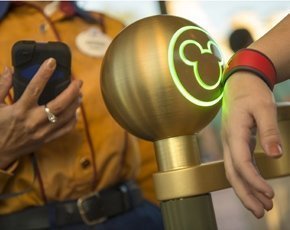
Walt Disney Company Parks & Resorts have started using bands that use RFID (radio frequency identification) technology. The MagicBand wearable
devices started in the beginning of 2014. These devices can be read by short-range and long-range readers at Walt Disney World
Resorts.
Disney decided to invest $1 Billion Dollars in a new wearable technology experiment. With this new technology you will be able to do several things like to enter the Disney parks and hotel rooms. With this device you can also purchase food and gifts,
use fast-track services and even link Disney photographs to an online account with a swipe of their
arm. This is something that you would want to use "EVERYWHERE".
Here are some questions that I would like to be answered.
1. Would you spend more that a week (if you had the money) using the Disney Magic Band?
2. What do you think of Disney doing this?
3. Do you think that more people will use this with all that it can do?
Any other comments, thoughts that you have about this...
A newer
technology that’s getting a lot of attention this week is the Hendo hoverboard.
This product will not be to unfamiliar to those who have seen the hoverboard in
the Back to the Future series. However, the current prototype could hardly be
compared to the hoverboard that was seen in the films. The Hendo hoverboard
uses magnetic fields for hovering which means that it requires a smooth metal
surface to hover over. Arx Pax, the company that created the hoverboard,
believes that the technology could eventually be developed to work on any
surface. Here is a video that shows what the current hoverboard can do.
It is likely
that most of you have already heard of using a similar technology for bullet
trains. However, the change in technology that Arx PAx is presenting is to
bring this technology to more stationary objects and a system that will
eventually be able to operate on any surface. Arx Pax believes that there are
countless areas where this technology can be applied, and honestly, the hoverboard
for humans doesn’t seem to be where they are focusing. The idea originally
began with a hope of being able to levitate buildings to protect them from
earthquakes. Now they are also talking about solutions to help company’s move inventory
in warehouses and more efficient ways for aircraft to take off.
Undoubtedly,
this technology does have the potential to change the way we live and work. If
this technology is developed to the point where it can work on any surface, it
could likely change the way that we go anywhere.
What do you
think the potential for this kind of technology is?
Learn more about the Hendo hoverboard and the company in these articles:
Here is something that I found while reading this article, ""Two million people get locked out of their homes in New York every
year," Behar said in an interview with Business Insider. "The thing
Jason and I have heard constantly is 'I hate keys.' So it seems like a
good problem to solve.""
There is a new device that is called August. The article that that I was reading said, "August is another company exploring the buzzy "Internet of Things" trend..." There is another company called Nest which is the creator of the well known smart thermostat and the smoke detector. This is well known because Google bought it for $3.2 billion in January.
As of now, August is only making the smart lock, but they are planing to expand into "other smart stuff." The site is saying that, "The lock has been around for about a
year, but only in limited quantities." I was also told that they are going for $250. The August works by Bluetooth and the app on you cell phone. It is also really simple to instal.
The August web site said that it is a "safe, simple, and social way to manage your home’s
lock." The nice part is that it lets you control who can enter and who can’t enter your house, and you can do that from your smartphone or computer. So, this means that there is "no more giving out your keys/codes to your friends."
(WAIT, what if our phone gets stolen...) I am so glad that you asked. You just have to log out of your device. You can read about what to do by going to the link above.
For those who spend an endless amount of time price-matching items, Wal-Mart's new Savings Catcher service is the perfect tool for you. Wal-Mart has long been known for their low prices compared to their competitors, but this new shopping feature just may help you save even more!
HOW IT WORKS
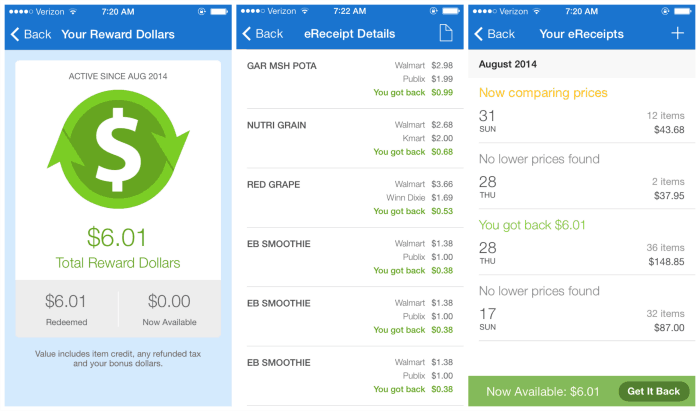
Instead of filtering through the weekly sale ads to find the best prices, the Savings Catcher simplifies the solution to a complex problem. Rather than matching advertised sales prices at the checkout line, the customer can now download the Savings Catcher app from either Google Play or Apple's App Store (also available on Wal-Mart's website). First, there are two ways to discover whether you're eligible for any savings on the items you bought: (1) Scan the receipt with your smartphone or (2) Type the receipt number into Wal-Mart's shopping app.
Next, Wal-Mart compares you're recently bought items from their stores with the sales prices of its competitors. Once it finds a lower price from another competitor, it displays the difference between the prices and automatically funds the savings onto an electronic gift card. To redeem your gift card, either print your savings receipt or bring your phone with you and the cashier will scan the barcode.
Here's a video tutorial about Wal-Mart's Savings Catcher:
CONCERNS
However, there is a drawback to using the Savings Catcher in comparison to traditional price matching at the register. The service takes up to three days to notify the customer of any savings. To be equitable, this process is prolonged because it allows Wal-Mart to price-match on a consistent and effective basis. Another 'catch' to this innovative idea--there's a limit of seven receipts (scans) per week. Hopefully, no one needs to shop at Wal-Mart, or any store, more than seven times in a week. Some other important factors are in the fine print: the app mostly covers only grocery, health, and beauty items. Sorry, that 1080p 120Hz LED-LCD television that's overpriced at your local Wal-Mart won't be eligible. Also, store brand or private-label items aren't able to get you money back simply because they aren't sold anywhere else.
PRICE-MATCH SAVINGS
Sci-Tech Today writer, Michael Lee, made several small trips and one large trip to Wal-Mart to test out their new service. For the multiple small shopping trips Michael made, he saved $11.99 in price matching on approximately $300 spent. On the big shopping trip, he spent $214 and got back $7.92. Although the savings aren't eye dropping, it's an easy way to pay for your dinner that night.
IS IT WORTH IT?
The question that comes to mind is whether or not Wal-Mart's Savings Catcher is worth using or not. It's tough to say whether or not its meant for all types of customers, but for the casual shopper it is definitely an easy steal. Especially if you tend to diversify where you shop at. In conclusion, to be able to save money at the palm of your hand with the assistance of technology is remarkable.
The question is whether or not consumers as whole believe it is worthwhile? Also, should Wal-Mart look to expand the eligible product line beyond just the basic essentials such as grocery, healthy, and beauty items? What else could Wal-Mart improve with their Savings Catcher service?
In the market futuristic payment systems, it would seem that
Apple Pay and Google Wallet have gotten most of the hype. However, it would
appear that there is another form of payment emerging that could greatly
decrease the size of our wallets. Say hello to Plastc Card. Yes, that is the
real name and not just a spelling error. This new card can store the
information from up to 20 other cards. The cool thing is that not only does it store
debit can credit cards, but it will also work for gift cards, loyalty cards,
and access cards to buildings. They say that basically any card that has a
magnetic strip can be stored on the card. However, according to early reports
that will not include your driver’s license. Well, I guess we can't have everything.
Using the card will be quite easy for anyone familiar with
e-readers, since the card will come with a built in e-ink screen. This screen
will allow users to swipe to choose a form of payment. It will also show a
picture of you along with your signature directly after you make a purchase,
making it a lot scarier for anyone who tries to steal your card. But if your
card is stolen, the chances of them making it to a the checkout line with your
card is pretty slim since the card is automatically deactivated once it gets a
certain distance away from your phone. Additionally, you can elect to receive a
message on your phone every time a payment is made from your Plastc Card. These
features will likely make Plastc Card a safer card to have in your wallet than
a normal card, let alone the fact that it will just be fun to use. Check out the
video below for a rundown on Plastc Card.
Does having a card like this seem appealing to you?
To read the full article of Plastc Card click here
America's Richest vs Social Media
By: Jacob Gilmore
Social media is a Web service or activity that nearly every person engages in on a weekly or daily basis. Parents use it to connect to old friends, kids use it to create more friendships, and many more. However, what if I told you that a significant amount of America's richest people do not use social media of any form?
In a study of the wealthiest segment of investors, 2014 $25 Million Plus Investor, Spectrem found that 31% of investors do not use any social media platforms. Also, 57% of the previous 31% say they are concerned about the privacy of their information.
As mentioned earlier, age plays a significant role in whether people use social media, as well as how/what they use it for. Among the $25 Million Plus investors, 59% of those aged 65 or older don't use social media. For those investors under the age of 56, 23% say they don't use social media whereas only 16% of investors 55-65 live in a "social-media-free" life.
Only one-half (52%) of the $25 Million Plus investors use Facebook, 40% are on LinkedIn (a professional networking site), and about a quarter (24%) use YouTube. The last and most surprising statistic is that only 17% overall use Twitter for personal and/or professional use.
Now we come back to the question: does age matter when it comes to social media? Does wealth classification also play a role in the likelihood of social media use?